← When Everyone Has an Agent
A cup of espresso with golden crema on a saucer, steam rising, on a dark surface

KEYNOTE · GenAIECommerce 2026 · RecSys · Minneapolis

When Everyone
Has an Agent

From better decisions to better markets

Patrick Jordan

September 28, 2026
01

Before we start

The opinions in this talk are my own, not my employer’s.

Everything here draws on public research. The espresso market is a stylized example.

02
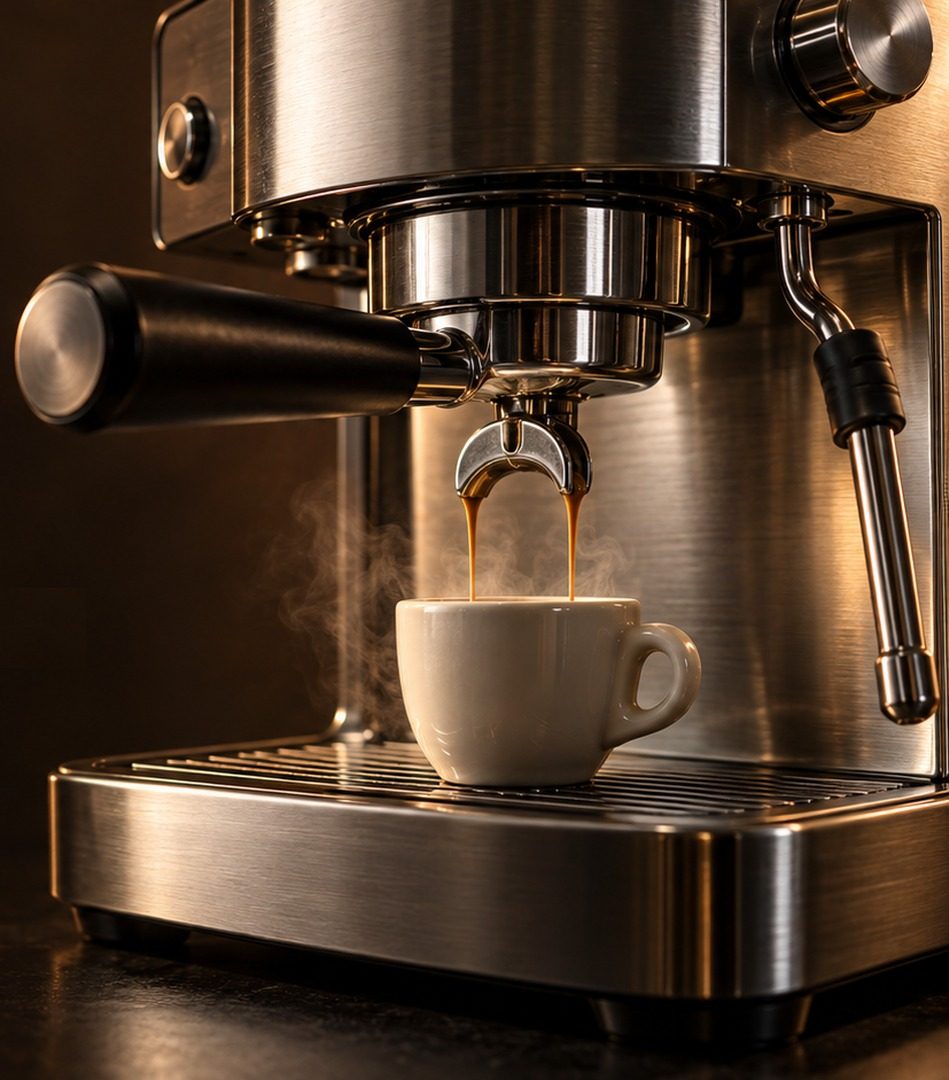
A stainless espresso machine pulling a shot into a white cup, steam rising, on a dark counter

A motivating example

“I want an espresso
setup for home.
About $800.”

Today

Forty tabs, reviews, and sponsored results

I do the searching, comparing, and second-guessing.

Tomorrow

I ask my agent

It talks to the merchants’ agents on my behalf.
03

The espresso market

Five machines, one buyer

MachineFit rPrice pUtility UFee (5%)
A0.92$600320$30.00
B0.94$650290$32.50
C0.98$790190$39.50
D0.70$550150$27.50
E0.58$450130$22.50

Buyer utility

U = 1000 r − p

C fits best. A is the best deal. A good recommender should surface A.

A fee-maximizing platform earns the most on C.

Stylized example. Budget $800; outside option U = 0.

04
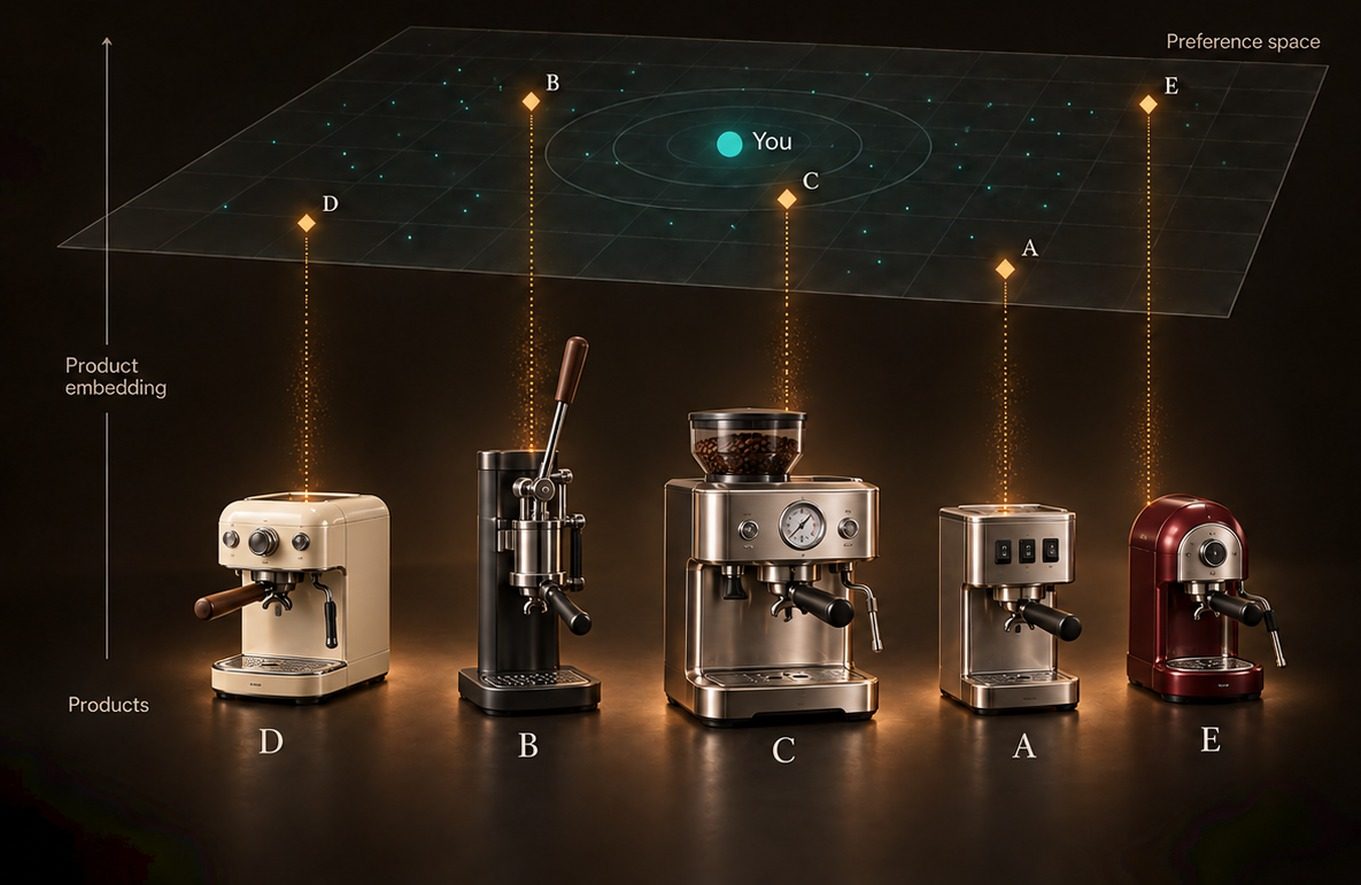
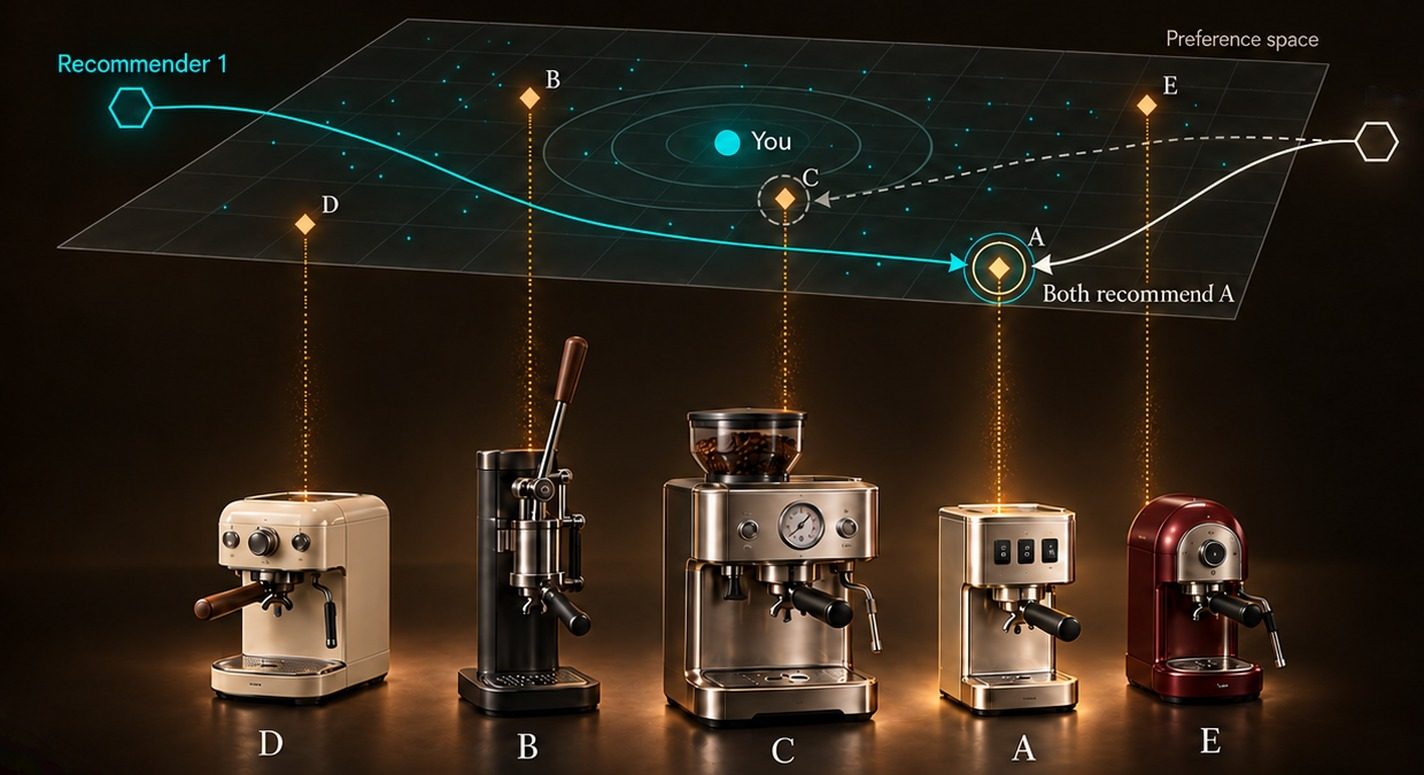
A tilted grid labelled preference space. A teal point marked You sits among faint teal buyer dots, with product points B, C and D nearby and A and E farther away. Glowing dotted lines drop from each product point to its espresso machine below: D a cream retro machine, B a lever machine, C a large dual-boiler with grinder, A a compact steel machine, E a red capsule-style machine.

Better decisions

Preferences become vectors

Buyers are points: me, and everyone like me.

Products are points in the same space.

Recommending means finding what’s near.

Nearness is relevance r.
Price tips the choice from C to A.
05

Better decisions

This is decision theory:
one agent, one user, maximize fit.

But my agent doesn’t ask
just one recommender.

06
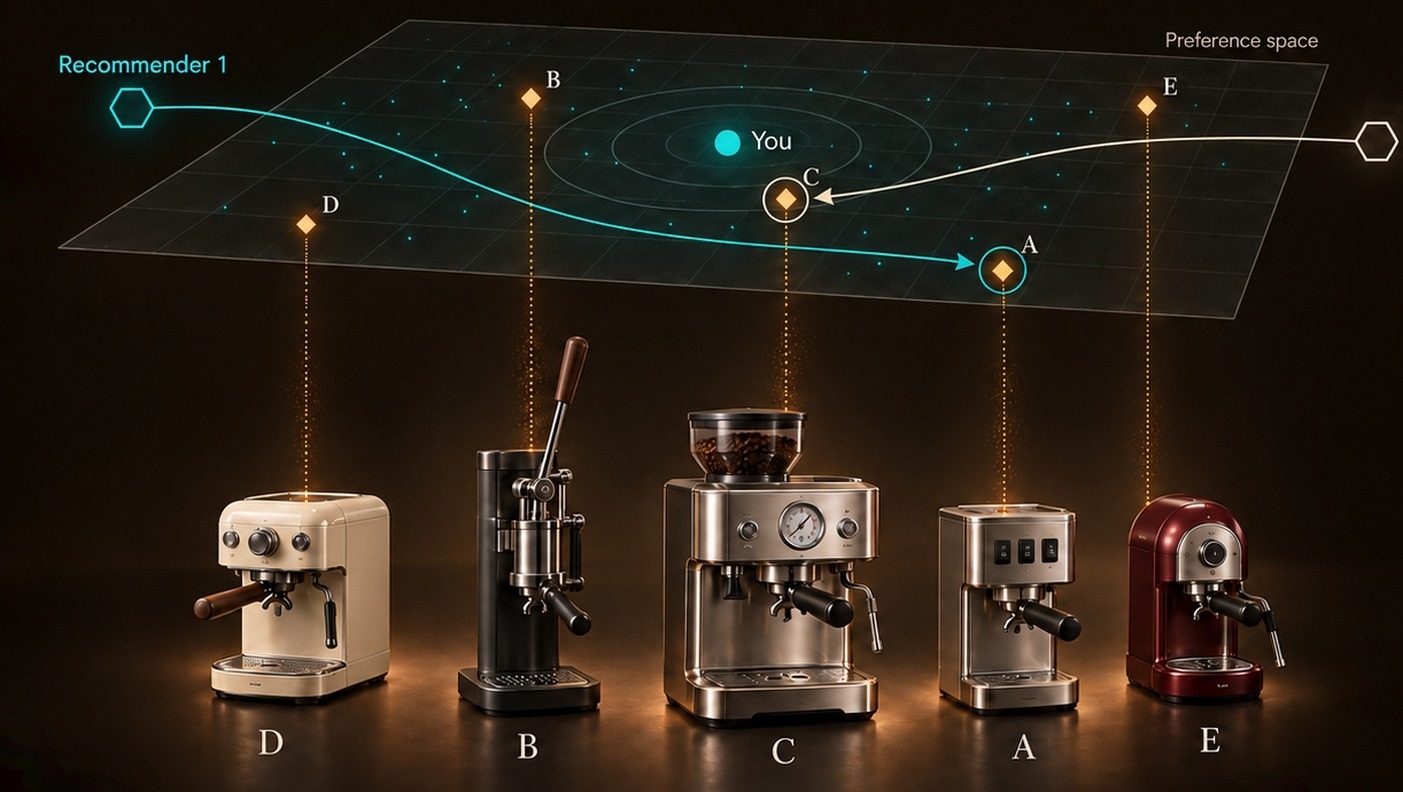
The preference-space grid above five espresso machines. Recommender 1, a teal hexagon at the left, draws a teal arrow to product A. Recommender 2, a cream hexagon at the right, draws an arrow to product C. The teal You point sits between them.

Recommendation as a game

Competing recommenders pick locations

Recommender 2

Each recommender agent chooses which point to put in front of my agent.

My agent takes the best offer.

That is a
facility-location game.
Ben-Porat & Tennenholtz, NeurIPS 2018 · Ben-Porat, Rosenberg & Tennenholtz, AAAI 2019 · Tennenholtz & Kurland, CACM 2019

07

Why the game matters

Competition changes what gets shown

One recommender

Maximizes its fee: shows C, D, E

Buyer picks C

Buyer utility

190

Platform fee

$39.50

Two competing recommenders

Both show A

Buyer picks A

Buyer utility

320

Platform fee

$15 each

Equilibrium: neither recommender gains by changing its list, given the other’s. Every pure equilibrium shows A, and the buyer gains 130.

Assumes the buyer buys only displayed items, compares lists at no cost, and prices are fixed; the commission is split equally.
Cf. Inderst & Ottaviani, AER 2012 · Walunj et al., Performance Evaluation 2025

08
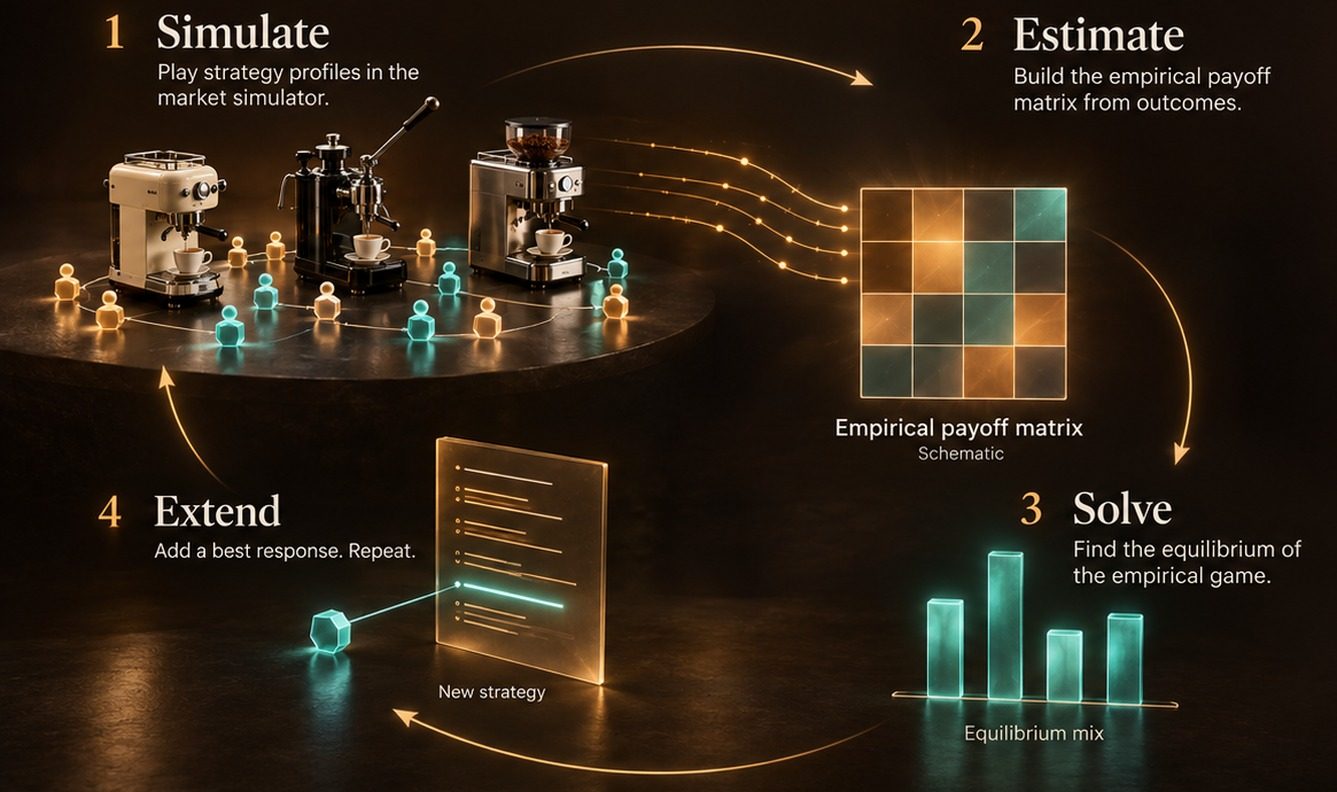
The preference-space grid above five espresso machines. Recommender 1's teal path and Recommender 2's path both end at product A, labelled Both recommend A. Recommender 2's earlier dashed path to C shows the move it abandoned.

Finding equilibria

Best responses settle — when the rules allow

Recommender 2

Top-K welfare under competing creators

Yao et al., ICML 2023

Supply-side equilibria

Jagadeesan, Garg & Steinhardt, NeurIPS 2023

Competition under learning

Jagadeesan, Jordan & Haghtalab, AAAI 2023

Creator incentives on curated platforms

Hron et al., ICLR 2023

Illustrated here: the espresso example

Best-response dynamics: each agent moves toward the buyers it can win.
09

When the players are LLMs

What changes when agents play the game

Strategies are language

Pitches, explanations, and framing become the actions.

Rationality is bounded

Agents approximate best responses; they don’t compute them.

Behavior depends on the model

Swap the model and the market outcome moves.

Adaptation in context

Agents learn within a conversation, not only across rounds.

Each one strains the assumptions behind the equilibria we just saw.

Dütting, Mirrokni, Paes Leme, Xu & Zuo, WWW 2024 · Dubey, Feng, Kidambi, Mehta & Wang, KDD 2024

10

Evidence

Agents take the first offer

60–100%

of the time, LLM buyer agents chose the first proposal they received.

Third proposals: near zero. A 10–30× first-mover advantage across every model tested.

1st offer

Machine C · $790

Accepted

2nd offer

Machine B · $650

Not compared

3rd offer · my best value

Machine A · $600

Never read

Illustrative: the espresso market

Speed beats quality. We can’t reason about this on paper — we have to simulate it.

Bansal et al., Magentic Marketplace, arXiv 2025 · See also: Hong et al., arXiv 2026 · Allouah et al. (ACES), arXiv 2025 · Fish, Gonczarowski & Shorrer, 2024

11
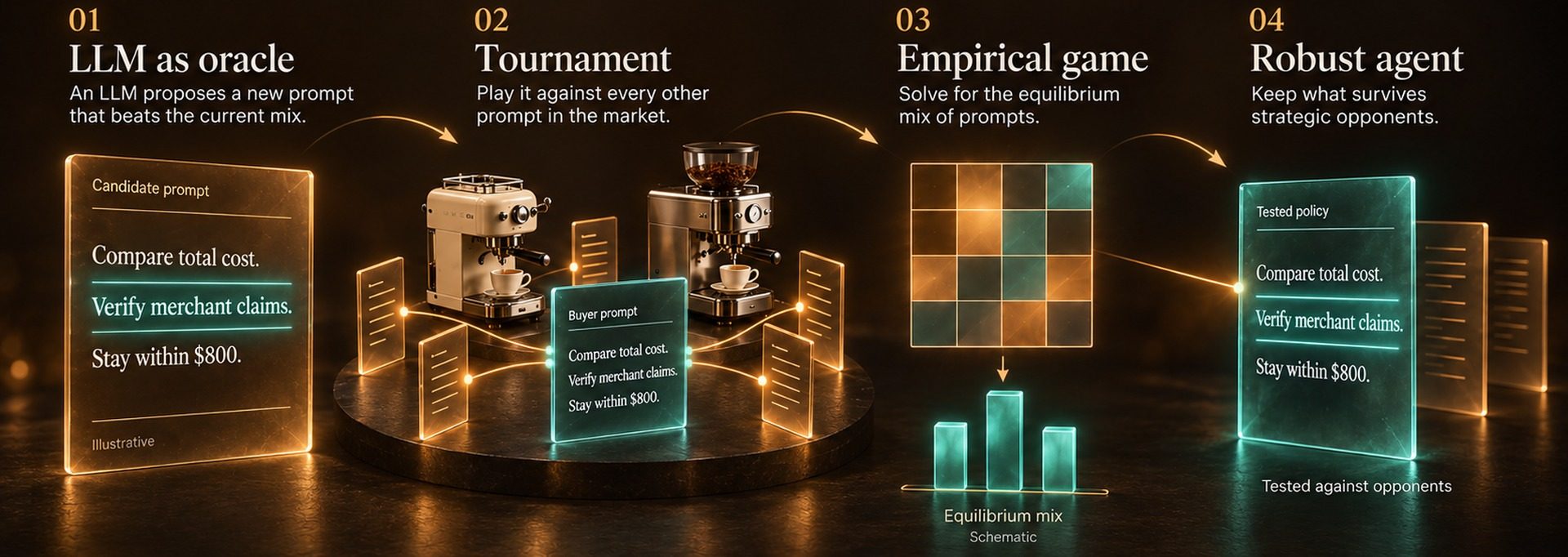
The EGTA loop drawn as a cycle. 1 Simulate: espresso machines and merchant agents play on a market table. 2 Estimate: glowing lines feed an empirical payoff matrix. 3 Solve: teal bars show the equilibrium mix. 4 Extend: a new strategy card is added, and an arrow returns to Simulate.

Improving agents

Empirical game-theoretic analysis

We can’t solve these games by hand. We can simulate them.

In the espresso market, a strategy is a merchant agent’s prompt.
Wellman, AAAI 2006 · Jordan, Schvartzman & Wellman, AAMAS 2010 · Lanctot et al., NeurIPS 2017 (PSRO)
Wellman, Tuyls & Greenwald, EGTA survey, 2024

12
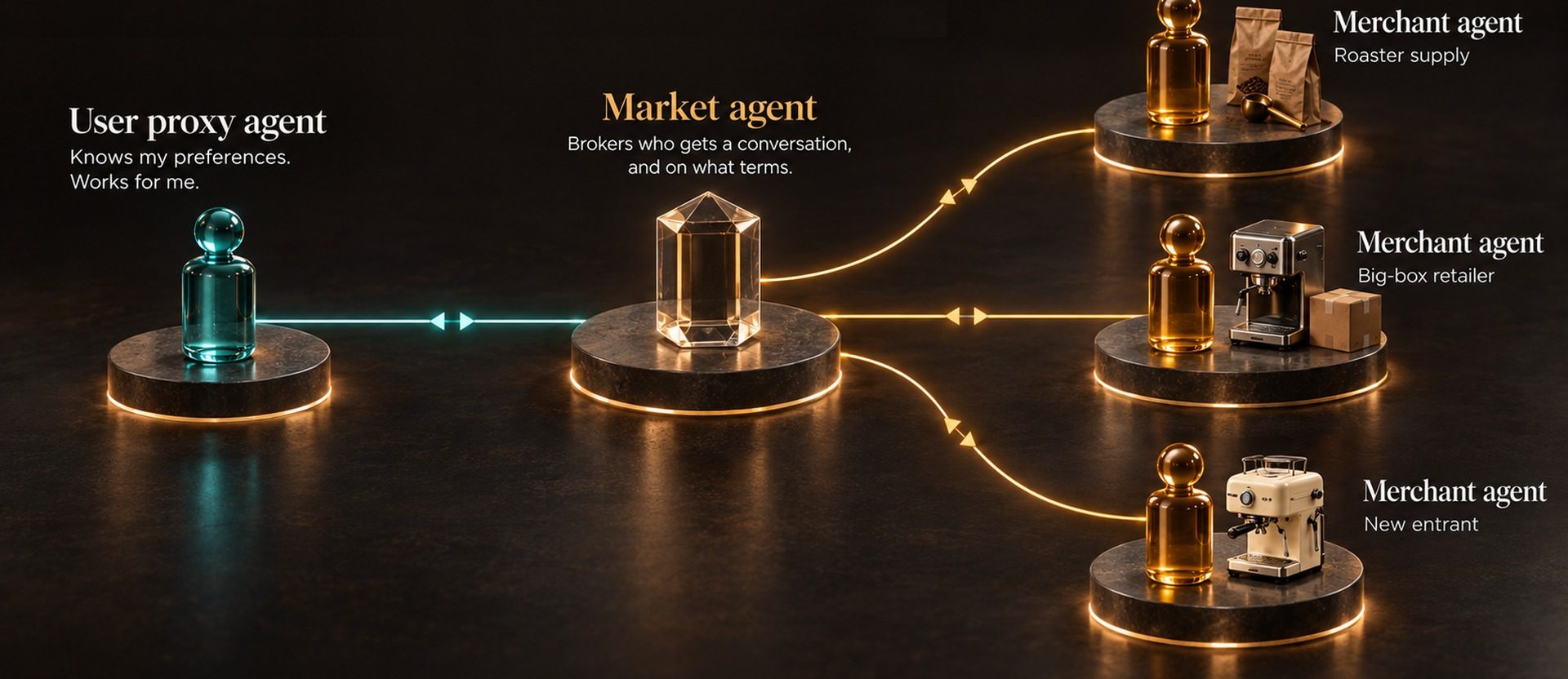
Four steps left to right. 01 LLM as oracle: a glowing candidate-prompt card reading Compare total cost, Verify merchant claims, Stay within $800. 02 Tournament: the buyer prompt plays against other prompt cards around espresso machines on a round table. 03 Empirical game: a payoff matrix feeds equilibrium-mix bars. 04 Robust agent: a teal tested-policy card, tested against opponents.

Improving agents

Prompts as strategies

Espresso

Harden my buyer agent’s prompt against persuasive pitches, and test it where it will actually play.

Gemp et al., arXiv 2024 · Jordan, Schvartzman & Wellman, AAMAS 2010 · Lanctot et al., NeurIPS 2017

13
A hand locks a portafilter into a stainless espresso machine as a fresh shot sits in a white cup on the drip tray.

Demo

Espresso Arena

Five machines. One buyer. Two offers.

01

Watch strategies gain and lose share

02

Solve, learn a best response, expand

03

Meet the buyers, before and after

QR code linking to patrickrjordan.com/demos/espresso-arena

patrickrjordan.com/demos/espresso-arena

Interactive · runs offline in your browser

14
A designed marketplace at night: lit stalls with espresso machines line curving paths with glowing edges. Amber and teal glass figures, the agents, move along the paths, and a teal agent walks the central path toward a round plaza.

The turn

From better agents to better environments.

The challenge is to design the environments where agents interact, so that useful behavior becomes strategically advantageous.
15
16
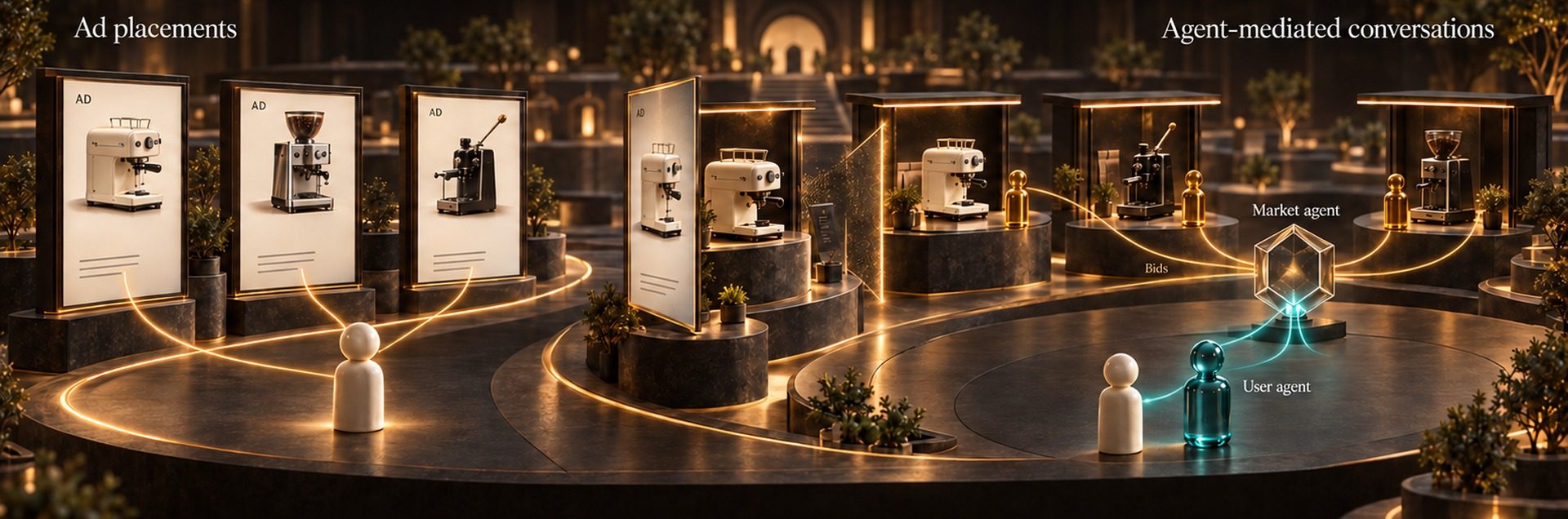
Two halves of one market. Left, Ad placements: espresso machines on billboard-style ad panels, with a shopper figure pulled by glowing lines toward each ad. Right, Agent-mediated conversations: merchant stalls with amber agents send bids to a crystal market agent, which connects to a teal user agent standing beside the shopper.

We’ve seen this before

Agentic commerce rhymes with ad tech

An impression becomes a conversation.

Price what you want more of.

Armstrong & Zhou, Economic Journal 2011 · de Cornière & Taylor, RAND 2019
17
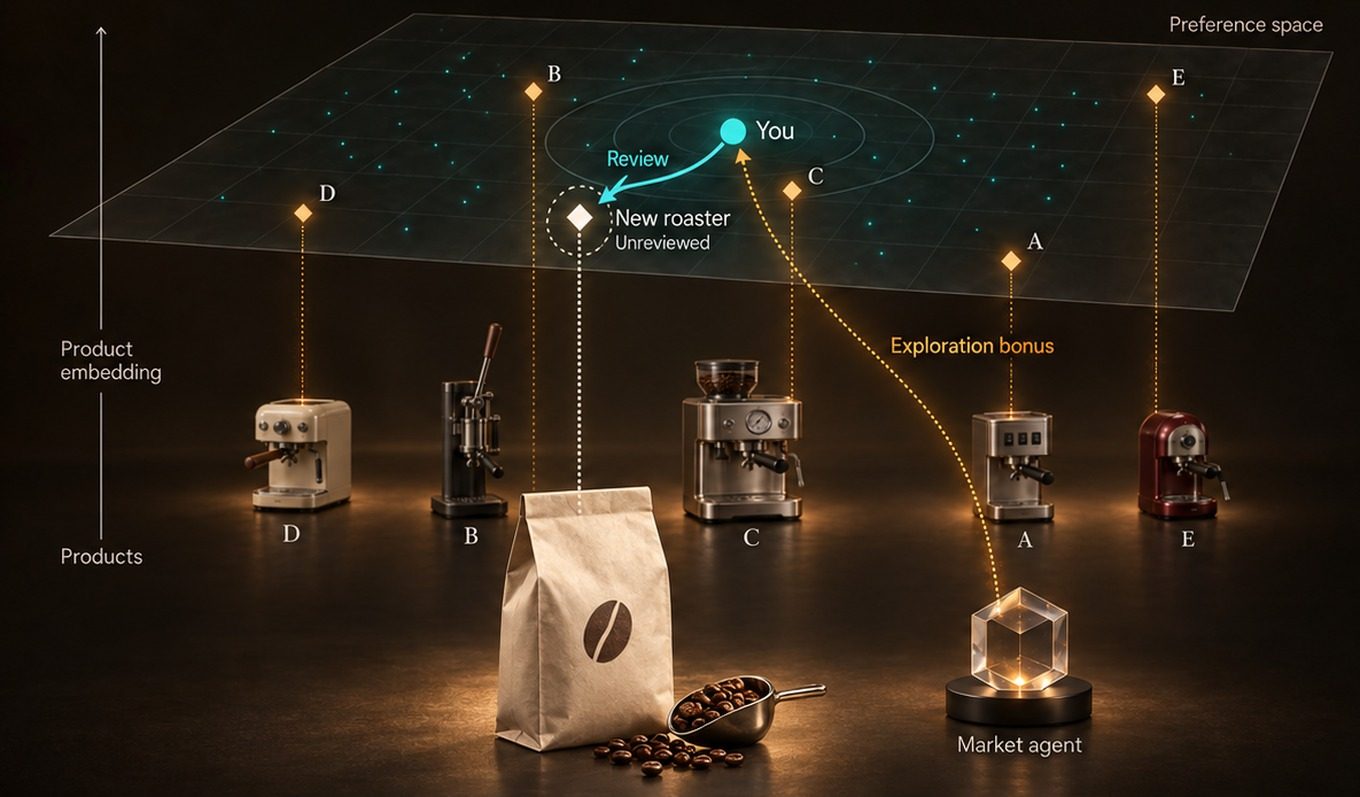
The preference-space grid above the five espresso machines. A white diamond labelled New roaster, unreviewed, sits near You, with a coffee bag below it. A teal Review arrow runs from You to the new roaster. A crystal market agent below sends a dotted amber Exploration bonus line up to You.

Keeping markets open

Subsidize exploration

My agent’s attention is scarce. It will stick with known merchants.

The market agent pays a bonus for reviewing a new or unfamiliar merchant.

Discovery stays open, and incumbents can’t lock in.

Kremer, Mansour & Perry, JPE 2014 · Mansour, Slivkins, Syrgkanis & Wu, OR 2022 · Wang et al., RecSys 2023

18
A sunlit open-air market. A grey-haired man talks with a coffee roaster in an apron who holds up a bag of beans at her stall, beside an espresso machine. Shoppers browse produce stalls behind them.

The world we can build

An advocate
for everyone

Every person has an agent that works for them, not for the platform.

Markets as
design objects

Three knobs we control:

Access

which offers reach my agent

Payment

who gets paid, and for what

Mobility

who can switch, who sets the rules

Hagiu & Jullien 2014 · Hagiu & Lee 2011 · de Cornière & Taylor 2019

19
A steaming cup of espresso on a saucer at the lower right of a dark, warmly lit surface.

When everyone has an agent

Better decisions

one agent, one buyer

→

Games

competing recommenders

→

Better agents

EGTA, learned responses

→

Better markets

access, payment, mobility

We have the tools.

Let’s reshape the world.

QR code linking to the talk page with slides, references, and the demo

Thank you · Patrick Jordan

Slides, references & demo · patrickrjordan.com/talks/when-everyone-has-an-agent

20

Use ← → or J / K to move between slides. Each slide number is a link to that slide.